
Local SEO for Doctors: The Complete 2026 Strategic Guide to Ranking #1 in Your Area
Local SEO for doctors is no longer optional — it is a critical growth strategy for clinics, hospitals, and individual…
Read More
Written by
Doctor Brandify Editorial Team Local SEO for doctors is no longer optional — it is a critical growth strategy for clinics, hospitals, and individual practitioners who want consistent patient appointments without relying entirely on paid advertising.
Today’s patients search online before choosing a doctor. They compare reviews, check Google Maps, visit websites, and often decide within minutes.
If your practice does not appear in local search results, especially in Google’s “Map Pack” (the top 3 local listings), you are losing high-intent patients to competitors.
This comprehensive guide explains everything doctors need to know about Local SEO — from foundational optimization to advanced strategies that improve rankings, credibility, and patient conversions.
Local SEO (Search Engine Optimization) is the process of optimizing a medical practice’s online presence to rank higher in location-based search results.
When patients search:
Search engines prioritize local results based on three main factors:
Local SEO ensures your clinic sends strong signals in all three areas.
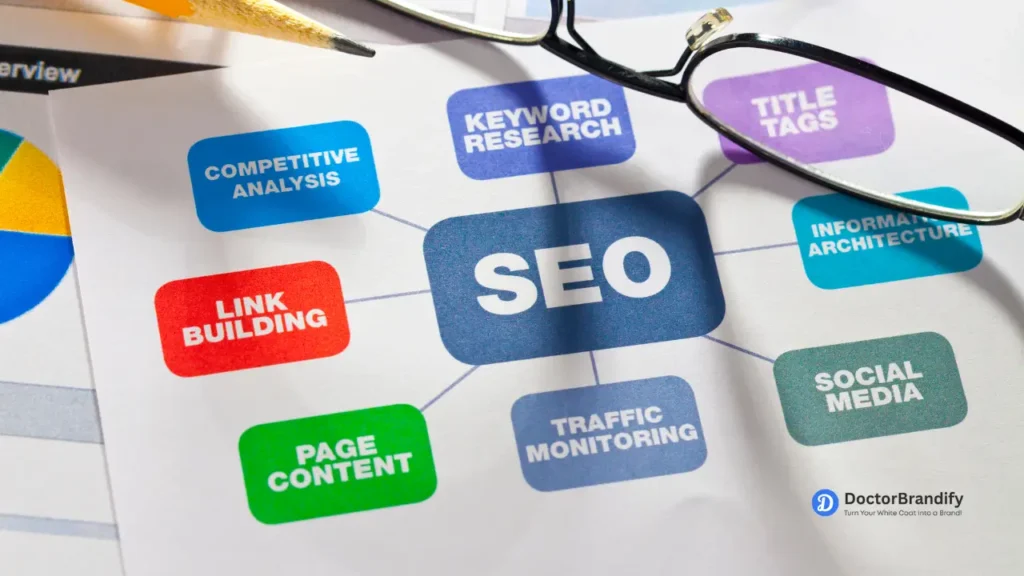
Unlike general browsing traffic, local searches have strong intent. Someone searching “dentist near me open today” is likely ready to book.
Patients evaluate reviews, ratings, website quality, and professional presentation before booking. Strong local visibility builds trust before the first visit.
Most healthcare searches happen on mobile devices. Local SEO helps you capture “near me” and map-based searches.
Paid advertising stops when your budget stops. Local SEO builds long-term visibility and sustainable patient acquisition.
Google uses a combination of signals to determine rankings:
To dominate local results, you must optimize across all these areas.
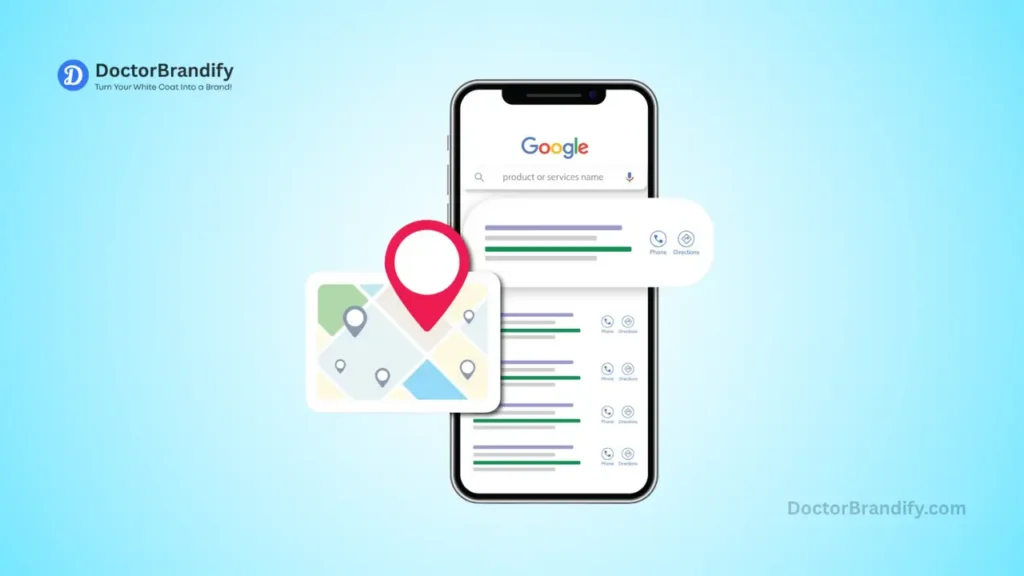
Your Google Business Profile (formerly Google My Business) is the most powerful local SEO asset for doctors.
Primary category should reflect your main specialty:
Secondary categories can include related services.
Naturally include:
Avoid spammy keyword stuffing.
Clinics with photos receive more clicks and direction requests.
Make it easy for patients to contact you directly from search results.
Use Google Posts to share:
Regular updates signal activity and improve engagement.
NAP stands for Name, Address, and Phone Number.
Your NAP must be identical on:
Even small inconsistencies (like “Road” vs “Rd.”) can reduce ranking trust signals.
Use the exact same formatting everywhere.
You must understand what patients are actually searching for.
Long-tail searches convert better:
These may have lower search volume but higher booking potential.
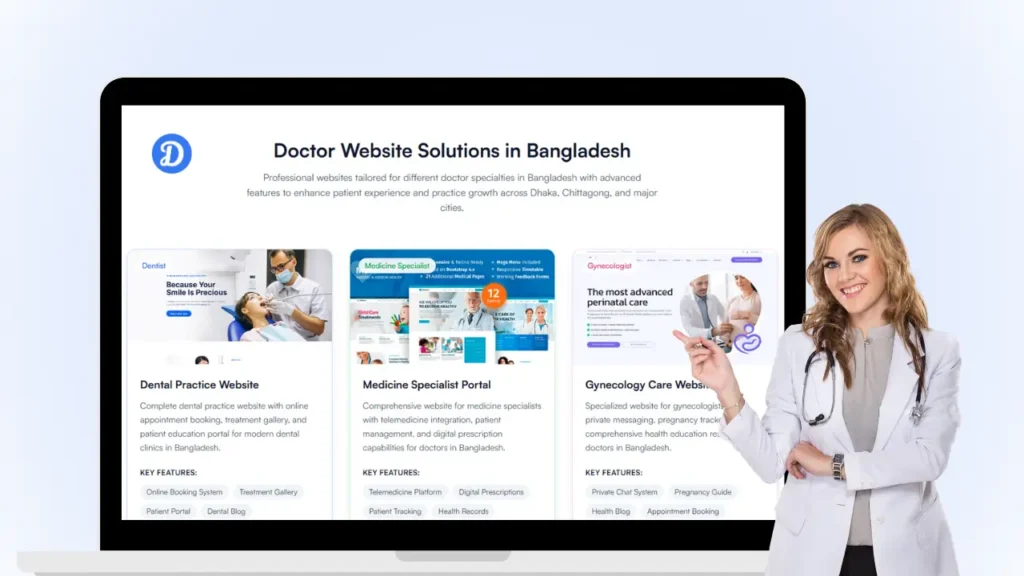
Your website must clearly communicate:
Each major treatment should have its own page:
Each page should include:
Check out DoctorBrandify Web Development Services
Include specialty + location
Example: “Best Cardiologist in Dhaka | Dr. [Name]”
Encourage clicks with benefit-focused copy.
Use H1, H2, H3 properly for structure.
Link related services together.
Display phone and address in footer and contact page.
Reviews influence both ranking and patient decisions.
Professional responses show:
Never argue publicly.
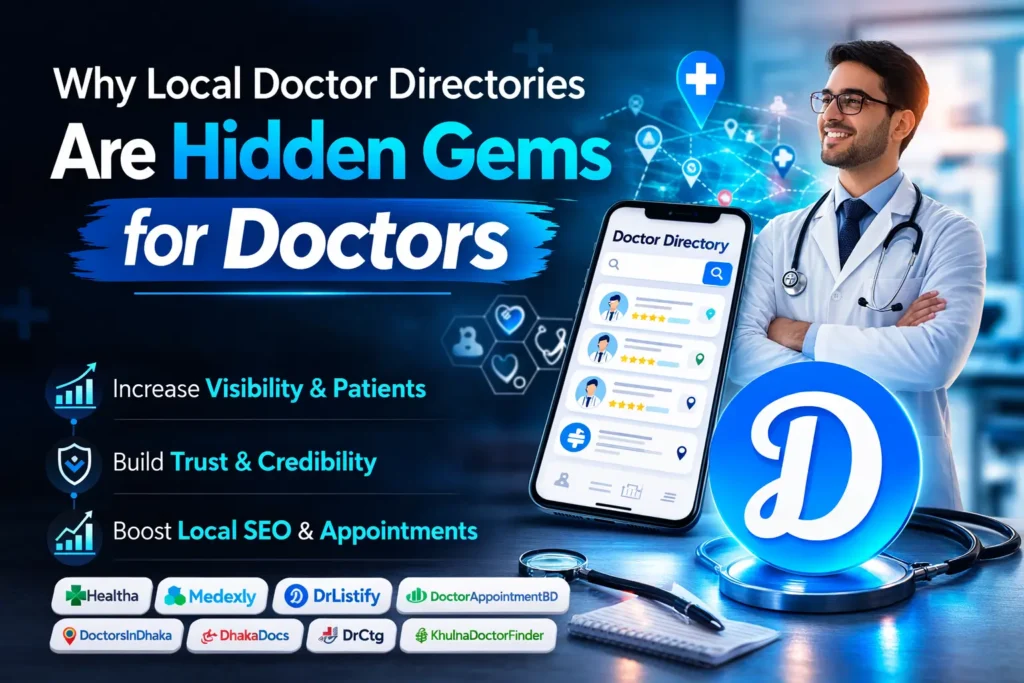
Citations are mentions of your practice online.
Submit to:
Quality matters more than quantity.
Backlinks improve authority.
Ways to build them:
Authoritative backlinks improve both organic and local rankings.
Schema helps search engines understand your website.
Important schema types for doctors:
Benefits:
Most local searches happen on mobile.
Your website must:
Google uses mobile-first indexing.
Search is evolving beyond traditional rankings.
To optimize for AI-powered search systems:
AI systems prioritize trustworthy, structured, experience-based information.
Publishing educational content helps:
Blog topics examples:
Add local context when possible.
Avoiding these alone can significantly improve visibility.
Monitor:
Measure monthly progress.
Week 1:
Week 2:
Week 3:
Week 4:
Consistency over time leads to compounding growth.
Local SEO for doctors is the process of optimizing a medical practice’s online presence so it appears in location-based search results such as “cardiologist near me” or “best dermatologist in Dhaka.” It is important because most patients search online before booking an appointment. A strong local SEO strategy helps doctors rank in Google Maps and local search results, increase visibility, build trust through reviews, and attract high-intent patients without relying solely on paid advertising.
Local SEO is a long-term strategy, but many doctors begin seeing improvements within 4 to 12 weeks if optimizations are done correctly. Factors such as competition level, review count, website quality, and consistency of business information affect results. Practices in highly competitive cities may take longer, while clinics in smaller areas may rank faster with proper optimization.
To rank in the Google Map Pack, doctors must fully optimize their Google Business Profile, select the correct primary category, maintain consistent Name, Address, and Phone number (NAP) across all platforms, collect high-quality patient reviews regularly, and ensure their website is locally optimized with relevant keywords. Engagement signals such as calls, direction requests, and profile clicks also influence rankings.
Yes, online reviews are one of the strongest local ranking factors. Google considers review quantity, quality, recency, and response rate when determining rankings. Additionally, patients trust practices with higher ratings and recent positive feedback. A consistent review generation strategy significantly improves both visibility and patient conversions.
Doctors should target location-based and intent-driven keywords such as “orthopedic surgeon in Chittagong,” “best pediatrician near me,” or “diabetes specialist in Uttara.” Long-tail keywords that include treatments, symptoms, or specific neighborhoods often convert better. Voice-search-friendly phrases like “Which ENT doctor is open now near me?” are also increasingly important for AI-driven search systems.
Yes. While a Google Business Profile is essential, a professional, SEO-optimized website strengthens authority, improves rankings, and increases trust. A website allows doctors to create detailed service pages, publish educational content, add structured data (schema markup), and convert visitors into booked appointments. Google uses website quality as a key local ranking signal.
To optimize for AI search and voice queries, doctors should create clear, well-structured content that directly answers patient questions. Adding FAQ sections, using conversational language, implementing structured data, and regularly updating medical content improves visibility in AI-generated search results. Providing accurate, experience-based, and trustworthy information helps search engines recognize medical expertise and authority.
Local SEO for doctors is about visibility, credibility, and patient trust. It is not just technical optimization — it is digital reputation management combined with strategic content and authority building.
When executed correctly, local SEO:
Healthcare is competitive. Patients choose doctors they can find, trust, and contact easily.
If your practice is not optimized for local search, now is the time to act.

Stay updated with the latest trends and insights in the healthcare industry.
Local SEO for doctors is no longer optional — it is a critical growth strategy for clinics, hospitals, and individual…
Read More
In today’s healthcare environment, being a skilled doctor is not enough. Patients now search online before choosing a physician. They…
Read More
In today’s digital-first world, patients no longer rely only on word-of-mouth referrals. They search online before choosing a doctor. While…
Read More
In today’s digital age, finding a qualified doctor should not be a struggle. With the rise of dedicated healthcare directories,…
Read More
Finding the right doctor is no longer just about proximity — it’s about credibility, specialization, accessibility, and relevance. For patients…
Read More
Facebook remains a top platform for patient discovery, reputation building and appointment growth — but 2024–2026 saw major changes: stronger…
Read MoreJoin hundreds of successful medical professionals who have transformed their online presence. Get a personalized digital strategy tailored for your practice.
2500+
Medical Websites
43%
Patient Growth
98%
Client Satisfaction
24/7
Support Available